
News
Delhi’s Coolest May in 36 Years: Record-Breaking Temperatures and Abundant Rainfall


Image: PTI
Delhi has recently witnessed a remarkable drop in temperatures during the month of May, marking it as the coolest May in the past 36 years. This significant shift can be attributed to the abundant rainfall that showered the city over the course of two weeks.
Surprisingly, Delhi encountered an unusual 11 days of rainfall, which is quite uncommon for this hot summer month. Data provided by the India Meteorological Department (IMD) reveals that the average maximum temperature recorded in May this year was 36.8 degrees Celsius, the lowest since 1987. It is worth mentioning that in May 1987, the Safdarjung weather station recorded an even lower average maximum temperature of 36 degrees Celsius, according to IMD scientist Kuldeep Srivastava.
To put things into perspective, the average maximum temperature in May last year was a scorching 40.1 degrees Celsius. The stark contrast in temperatures this year can be attributed to the five active western disturbances that affected the northwest plains of India. Srivastava highlighted that while the region usually experiences two to three western disturbances during this period, this year marked the fifth one.
Delhi received a staggering 111 mm of rainfall in May, which was 262 percent above the normal average of 30.7 mm for the month. The city has also witnessed above-normal rainfall in March, April, and May, accumulating a total of 184.3 mm during the pre-monsoon season. This figure represents an excess of 186 percent compared to the average of 64.4 mm.
Furthermore, the Safdarjung weather station did not record any instances of a heatwave throughout May, although other weather stations in the vicinity reported heatwave conditions. The copious rainfall and gusty winds not only provided relief from the scorching heat but also improved Delhi’s air quality. On Wednesday, the Air Quality Index (AQI) was recorded at 85, falling under the ‘satisfactory’ category. In contrast, on May 23, when there was no rainfall, the AQI soared to 198, according to data from the Central Pollution Control Board (CPCB).
Remarkably, data from the Commission for Air Quality Management (CAQM) shows that the average PM10 and PM2.5 levels from January to May this year have been the second lowest since 2016. The lowest levels were observed in 2020 due to the summer lockdown.
In conclusion, Delhi’s unusual weather patterns in May, marked by the lowest temperatures in over three decades and abundant rainfall, have brought relief from the scorching heat and improved air quality in the city.



News
Bulldozer action at house of Uttam Nagar murder case accused, parts of 3-storey building torn down.

Image Source: Twitter.
Four days after 26-year-old Tarun Kumar was beaten to death after a Holi dispute over a water balloon, civic officials carried out bulldozer action at the house of one of the accused in Delhi’s Uttam Nagar.
On Sunday morning, a crane reached JJ Colony and work began to break parts of a three-storey house linked to the accused. After that, workers with hammers broke more sections of the building.
A large number of police staff were present in the area during the action. Personnel from the Rapid Action Force (RAF) were also posted across the locality to keep the situation calm.
A senior police officer said the police are working with the civic agency during the removal of the illegal parts of the building. A statement from the civic body has not come yet.
Delhi Police have arrested six people and taken a minor into custody in the case. They also added charges under the SC/ST Act after claims that caste slurs were used during the attack.
The accused have been named as Umardeen, 49; Jummadeen, 36; Kamruddin, 36; Mustaque, 46; Muzzaffar, 25; and Tahir, 18. All live in A Block of JJ Colony.
Police said the incident took place on March 4. Tarun’s 11-year-old cousin was playing with a water balloon from the third floor of their home. The balloon slipped from her hand and fell to the street. Water from it fell on a woman living nearby. This led to an argument between the two families, who belong to different communities.
Police said the fight soon turned violent. Tarun was attacked outside his home with sticks, rods, bats and stone slabs. He was taken to a hospital, where doctors declared him dead.
Since the incident, tension has remained in the locality. After the attack, family members of the accused left their homes and locked the houses.
On Friday night, some vehicles parked outside the house of the accused were set on fire. Police are also looking into this case.

Representational Image | Source: PTI
Delhi saw very warm weather at the start of March. On Saturday, the maximum temperature reached 35.7 degrees Celsius. An official from the India Meteorological Department (IMD) said this is the highest temperature recorded in the first week of March in the last 50 years.
Weather data from the past five decades shows that the earlier highest reading for the first seven days of March was 34.8 degrees Celsius. This was recorded on March 5, 1999 at Safdarjung, the main weather station in the city.
With the temperature touching 35.7 degrees Celsius on Saturday, the city has now recorded the warmest day for the first week of March during this 50-year period, the IMD official said.
IMD data from 2011 shows that the next highest temperature during the first week of March was recorded in 2016. On March 4 that year, the maximum temperature reached 33.6 degrees Celsius.
Safdarjung station recorded a maximum temperature of 35.7 degrees Celsius on Saturday. This was 7.3 degrees above the normal level. The minimum temperature there was 17.4 degrees Celsius, which was 3.4 degrees higher than normal.
So far this month, the average maximum temperature in the city has been around 33 degrees Celsius. The average minimum temperature has been about 16.3 degrees Celsius. IMD data shows this is the highest level seen since 2022.
In 2022, the average maximum temperature for March was 33.4 degrees Celsius, while the average minimum temperature was 17.6 degrees Celsius.
The highest temperature ever recorded in Delhi during March remains 40.6 degrees Celsius. This reading was recorded on March 31, 1945.
At Palam station, the maximum temperature reached 33.4 degrees Celsius, which was 4.6 degrees above normal. The minimum temperature there was 18.3 degrees Celsius, about 4 degrees above normal.
The Lodhi Road station recorded a maximum temperature of 35.8 degrees Celsius, 7.8 degrees above normal. The minimum temperature there was 17.6 degrees Celsius, 4.6 degrees above normal.
At the Ridge station, the maximum temperature reached 36.4 degrees Celsius, which was 7 degrees above normal. The minimum temperature there was 19.1 degrees Celsius, about 3.9 degrees above normal.
Ayanagar recorded a maximum temperature of 36.1 degrees Celsius, which was 7.3 degrees above normal. The minimum temperature there was 17.3 degrees Celsius, about 4.1 degrees above normal.
The IMD also said that no rainfall was recorded at these stations during the 24-hour period on Saturday.
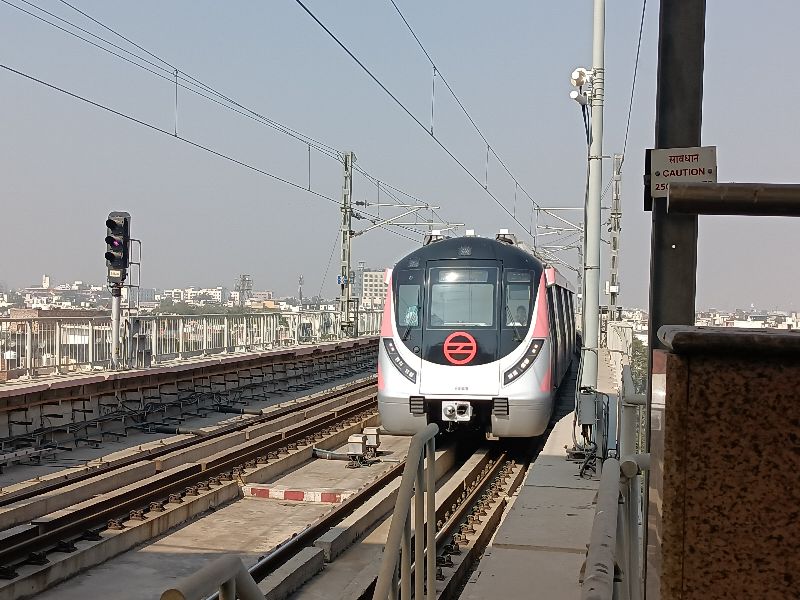
Prime Minister Narendra Modi will open several new projects of Delhi Metro Rail Corporation on March 8. The event will also mark the start of the country’s first full “Ring Metro” in Delhi. Delhi Chief Minister Rekha Gupta shared this information.
These metro works are part of the city’s transport growth plan. The cost of the projects is more than Rs.18,300 crore. The aim is to make daily travel easier for people and cut road traffic in the capital.
India’s First Ring Metro
A key part of the event is the opening of the Majlis Park–Maujpur-Babarpur stretch on the Pink Line. This part is 12.3 km long. After it opens, the Pink Line will run about 71.56 km in a full loop around large parts of the city. This loop system will help people move across many areas without long detours.
The raised track has stations such as Majlis Park, Burari, Jharoda Majra, Jagatpur-Wazirabad, Soorghat, Nanaksar-Sonia Vihar, Khajuri Khas, Bhajanpura, Yamuna Vihar and Maujpur-Babarpur. The work also has a bridge across the Yamuna River and a double-deck structure that carries a metro track along with a road flyover.
Magenta Line Extension
PM Modi will also open the Deepali Chowk–Majlis Park part of the Magenta Line. This raised route is 9.92 km long and has seven stations. After this step, the Magenta Line will run close to 49 km in total. Some parts of the track reach a height of about 28.36 metres, among the tallest raised metro tracks in the network.
Plans for More Metro Lines
At the same event, the prime minister will lay the first stone for three new routes under Phase V (A) of the metro plan. One route will link Ramakrishna Ashram Marg to Indraprastha in the Central Vista area. Two more routes will extend the Golden Line. One will link Aerocity with Terminal 1 of the airport, and the other will run from Tughlakabad to Kalindi Kunj.
Officials said these metro works will help travel across Delhi and nearby areas and may also cut traffic jams and air pollution.


Bulldozer action at house of Uttam Nagar murder case accused, parts of 3-storey building torn down.

Delhi Hits Highest Temperature In First Week Of March In 50 Years.

PM Narendra Modi to Open Delhi’s First Full Ring Metro on March 8.

Domestic LPG Price Hiked by Rs 60, Commercial Cylinder Up Rs 115 Amid Iran Tension

Delhi Woman Strangles 21-Month-Old Nephew in Park, Sits with Body

Speeding Car Hits Delivery Agent in West Delhi, Rider Dies on Spot.

Students to Get Fast Access in Delhi Metro Amid CBSE Exams.

Delhi’s January Air Quality Ranks Second Best in Recent Years.

Top 50 Most Influential Authors of 2025.

Delhi Man Shot Dead an Hour Before Birthday After Hug From Attacker

Top 50 Most Influential Authors of 2021

Book Review of Debutant Author, T. Shree, ‘What If….’

Top 50 Most Influential Authors of 2023

Top 50 Most Influential Authors of 2022
This Restaurant In Delhi Serves Food Inside An Actual Airplane

You Won’t Believe How AI Transformed Bollywood Divas into Stunning Barbies!
First PUBG-Themed Restaurant opens in Jaipur

Yami Gautam Unveils Her New Avatar in ‘OMG 2’: Get Ready to Be Amazed!

Exclusive Interview With The Author of ‘Daughter of the Night’ Nandini Gupta

Top 50 Most Influential Authors of 2024.

Man Calms Angry Elephant, Tourists Stunned by the Spectacle

DTC Bus Driver’s Seizure Leads to Tragic Collision in Rohini, One Fatality

6 killed, 2 injured in Bus-SUV Collision on Delhi-Meerut Expressway | Video

Viral video alert: Man brushing his teeth on Delhi Metro gains millions of views

Shocking: Man rams car into a group of people after spat with a biker (Video)

Man steals the show as influencer grooves to ‘Dilbar’ on street
-
 News4 weeks ago
Delhi Woman Strangles 21-Month-Old Nephew in Park, Sits with Body
-
 News1 week ago
Bulldozer action at house of Uttam Nagar murder case accused, parts of 3-storey building torn down.
-
 News4 weeks ago
Students to Get Fast Access in Delhi Metro Amid CBSE Exams.
-
 News4 weeks ago
Speeding Car Hits Delivery Agent in West Delhi, Rider Dies on Spot.
-
 News2 weeks ago
PM Narendra Modi to Open Delhi’s First Full Ring Metro on March 8.
-
 News2 weeks ago
Domestic LPG Price Hiked by Rs 60, Commercial Cylinder Up Rs 115 Amid Iran Tension
-
 News1 week ago
Delhi Hits Highest Temperature In First Week Of March In 50 Years.